Showing posts with label cardio. Show all posts

Sunday, November 20, 2016

PHYSICAL FITNESS

Physical fitness is the capacity to perform physical exercise, whose health-related components include body composition, cardio-vascular endurance, flexibility, muscular strength, and muscular endurance.
Body composition is the proportion of fat and fat-free mass in the body. It is common for people to gain weight and increase body fat as a result of a lack of exercise and poor nutritional habits.
If you're physically fit you'll look better, feel better and perform better. The only way to improve your physical fitness is through exercise. Exercise improves endurance and strength while reducing excess body fat and increasing muscle tone.

Tuesday, November 15, 2016

BENEFITS OF SPRINTING

Speed drills are a powerful health and fitness tool which aid in body fat reduction, muscle building and a skill critical in many sports. Many studies have shown that speed workouts are much more effective than steady-state cardiovascular workouts in producing body fat loss. Additionally, speed training helps build muscle thus coupling the lean effect of fat loss with improved muscle size and tone. The end result will be a faster and fitter you!


Monday, October 17, 2016

MILITARY CROSS-TRAINING: Calisthenics Plus a Conditioning Hike


This workout was modeled after physical training sessions common in the armed forces special operations community. Cardiovascular and muscular endurance are perquisites for these service members being that everything they carry on a mission, they carry on their backs. Marine infantry units complete twenty-five mile marches in under eight hours wearing forty pound packs and carrying their weapons.
This Flab-to-Fit workout will be somewhat less intense but will still develop core and leg strength as well as stamina using a combination of calisthenics and a conditioning hike.

Wednesday, September 28, 2016

CIRCUIT TRAINING FOR STRENGTH & ENDURANCE


The goal of circuit training is to develop strength and endurance through a systematic program involving various stations where exercises are performed. These exercises should be performed in a vigorous manner for a short period of time before moving on to the next station and different exercise.


Cardiovascular and muscular endurance circuits develop cardiovascular and muscular fitness through the use of calisthenics coupled with jogging. Individuals who train using the aforementioned workout and training principles enjoy three distinct benefits:
  • Progressive training and overload to gradually improve conditioning;
  • Ability to train individually or simultaneously with a group;
  • Improvement of both endurance and muscle tone in a single training session.

Tuesday, September 20, 2016

The Basic Cardiovascular and Muscular Endurance Circuit

This circuit is designed to improve cardiovascular and muscular endurance by exercising hard at eight stations with a slow one hundred meter (100m) jog used as recovery between stations. Each round is 1/2 mile in length.


This workout is designed to last forty-five to sixty minutes including a warm-up and cool down period. Well-conditioned participants should strive to complete three rounds of this circuit.

Tuesday, September 13, 2016

GENERAL CONDITIONING WORKOUT

A year-round general conditioning workout designed to gain and maintain an excellent overall state of conditioning. This workout includes exercises to develop cardiovascular endurance, core stability and maximum strength.


Cardiovascular endurance is trained and tested using a 1.5-mile run. Each 4 session cycle will include a best-effort time trial, two easy jogs and a fartlek workout. Fartlek is the Swedish word for "speed-play". During the fartlek session; the first and last half-miles are conducted as an easy jog with the middle half-mile run at a vigorous pace.
Core stability and local muscular endurance are developed and tested using abdominal crunches.
Lower body and upper body strength are developed and tested using the barbell squat and barbell bench press. The sessions are cyclic in nature; moving from reps of 5, to 3, then a 1 rep maximum lift. A one week of light lifting ends the cycle. Each work includes 3 sets of each lift. The first set is conducted at 50% of the training/max weight. The second set is conducted at 75% of the training/max weight. If you're doing sets of 5 with 100 pounds being the training weight; the first sets will be with 50 pounds, the second set at 75 pounds and the final set at 100 pounds. This protocol serves 2 purposes. First, it provides a specific warm-up using sub-maximal weight. Second, it conditions your body to lift heavier after you've already lifted. This will help reduce the risk of injury while training yourself to finish strong. The light week includes one set each at 5, 3 and 1 reps all at 50% of the normal training/max weight. As you get stronger, increase the weight in small increments and maintain the 50%-75%-100% lifting protocol.

TRAINING FOR ENDURANCE & STRENGTH

The goal of circuit training is to develop strength and endurance through a systematic program involving various stations where exercises are performed. These exercises should be performed in a vigorous manner for a short period of time before moving on to the next station and different exercise.


This circuit is designed to improve cardiovascular and muscular endurance by exercising hard at eight stations with a slow one hundred meter (100m) jog used as recovery between stations. Each round is 1/2 mile in length. During inclement weather, this circuit can be conducted indoors by substituting running-in-place or jumping rope for the 100m jog.

Monday, September 12, 2016

The Basic Cardiovascular and Muscular Endurance Circuit

This circuit is designed to improve cardiovascular and muscular endurance by exercising hard at eight stations with a slow one hundred meter (100m) jog used as recovery between stations. Each round is 1/2 mile in length.


This workout is designed to last forty-five to sixty minutes including a warm-up and cool down period. Well-conditioned participants should strive to complete three rounds of this circuit.


Sunday, September 11, 2016

Equipment-Free Circuits

Equipment-free circuits can be completed regardless of the location where conducted. These are commonly used by member of the armed forces; Marines and Sailors can conduct these workouts on the deck of a ship. Not having a gym or place to train is no longer a valid excuse!


http://hubpages.com/health/Cardiovascular-Muscular-Endurance-Circuit-I

Wednesday, September 7, 2016

Wednesday, August 24, 2016

CROSS-TRAINING FOR ENDURANCE & EXPLOSIVENESS

A cross-training session designed to increase explosiveness as well as cardiovascular and muscular endurance.
Several plyometrics exercises will develop explosiveness using different jumping drills. Each jump should be a best-effort attempt, so rest 30 seconds between jumps.
EXERCISE(S)
SETS
REPETITIONS
Heel raise - Butt kicks - Partial lunges - Trunk circles - Horizontal arm swings - Curl & press - Wrist curls - Jumping jacks
1
6


Vertical jump
5
1
Butt kick jump
5
1


Push-ups
1
15
Crunches
1
15
Air squat
1
15


Run
1
3 miles


Stretching: Calf - Hurdler - Groin - Lunge - Quad - Lower back - Triceps
2
10 seconds each

http://hubpages.com/health/GET-FIT-The-Exercise-Plan-for-14-20-August

Thursday, August 18, 2016

RESILIENCY TRAINING

Resiliency is the ability to recover quickly from change. This workout will test your resiliency by combining a variety activities in a single session to develop speed, strength and endurance using calisthenics, a conditioning hike and sprinting. 
The calisthenics portion of the the workout emphasized core and lower body movements including air squats, planks and crunches.
Short, explosive sprints were designed to enhance acceleration and quickness. The loaded sprints can be accomplished by pulling a sled, wearing a back pack and sprinting uphill. Keep the weight to about 15% of your body weight.
The conditioning hike was completed wearing a back pack load with 30 pounds. The goal is to improve endurance while carrying extra weight using a moderate pace (approximately 20 minutes per mile).
https://caloriebee.com/workout-routines/STRENGTH-CONDITIONING-Exercise-Plan-for-31-July-6-August

Wednesday, August 17, 2016

CORE & CARDIO WORKOUT


EXERCISE(S)
SETS
REPETITIONS
Mobility: Partial lunge with twist - Hip thrust - Bird dog - Air squat - Lunge stretch - High knees - Standing quad stretch - High knees - Standing glutes stretch - Donkey kicks - Butt kicks
1
6
Front plank + Side planks + Air squat **
1
30 seconds each
Push-ups
4
5
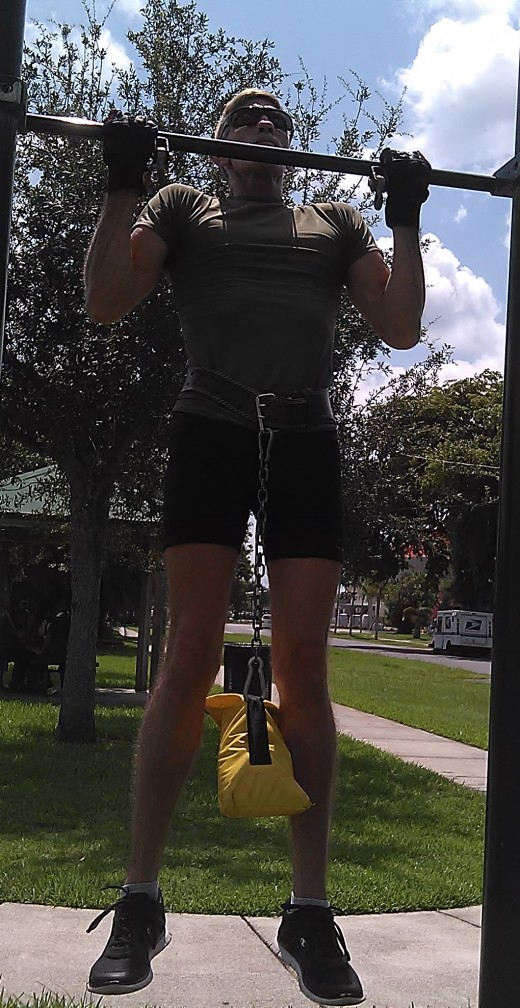
Pull-ups *
4
4
Crunches
4
10
Crunches
3
60 - 30 -15 seconds
Run
1
3 miles
Stretch: Calf - Hurdler - Groin - Quad - Lower back - Triceps - Delts
2
10 seconds each

http://hubpages.com/health/DAILY-EXERCISE-PLAN-7-13-August

Tuesday, August 9, 2016

WEEKLY TRAINING PLAN OVERVIEW

Many workouts can be completed in 30 minutes or less, but are intense. The workouts which develop cardiovascular endurance require more time since endurance is about sustaining activities over time.


DAY
OBJECTIVE
Sunday
Endurance & Speed
Monday
Muscular Endurance
Tuesday
Speed
Wednesday
Rest
Thursday
Cardiovascular Endurance
Friday
Strength & Endurance
Saturday
Rest

Monday, August 8, 2016

U.S. ARMED FORCES PHYSICAL TRAINING

Ready for an approach to physical training that consistently produces results? The physical conditioning programs utilized by the U.S. Armed Forces has transformed many relatively sedentary men and women into physically fit, combat ready service members capable of performing demanding physical tasks regardless of the clime or place.


Military fitness routines deliver results regardless of your abilities, background or experience. They are tailored to work for everyone and can be accomplished nearly anywhere. Department of Defense (DoD) Policy directs the armed services and all service members to "maintain physical readiness through appropriate nutrition, health, and fitness habits". The components of DoD Physical Fitness Program include:
  • Cardiovascular Endurance
  • Muscular Strength
  • Muscular Endurance
  • Desirable Body Fat Composition
The military services design and implement physical fitness programs to meet or exceed Defense Department policy using accepted training principles of physical conditioning. These programs and their workouts can be conducted nearly anywhere with a minimal amount of equipment or facilities.
This week's routine is fashioned using the components and principles utilized by the armed forces. Using common-sense, do-it-anywhere techniques this program will improve your strength and endurance while giving you a lean, toned look using balanced and challenging workouts.
New to military-style training? No worries, these easy to understand workouts will introduce you to to new and old-school exercises that have developed better bodies and enhanced the overall fitness of millions!

Wednesday, August 3, 2016

CORE STABILITY & CARDIO TRAINING SESSION


This training session included a calisthenics period followed by a three mile run. The calisthenics period emphasized core exercises.
Core stability is the ability to control the position and movement of the central portion of the body. The core serves as the body's movement and power regulator. An increase in core stability can help maximize one's balance and athletic performance. Additionally, well conditioned core muscles help improve posture and reduce the risk of injury.

Friday, July 29, 2016

Components of Physical Fitness


Developing a fitness base is important for both the health and performance benefits of a regular fitness regimen. A comprehensive program, or total conditioning, is designed to develop capabilities across all physical fitness components. Many athletes used the total conditioning approach when developing their off-season and pre-season workout plans. Members and services of the U.S. Armed Forces couple total body conditioning with military skills in order to best prepare for the rigors of combat. The components of physical fitness are:
a. Agility – the ability to quickly change directions;
b. Cardiovascular Endurance – the ability of the cardio-respiratory system to deliver oxygen and nutrients to muscles;
c. Coordination – the ability to combine simple movements into an efficient complex movement;
d. Flexibility – the ability to move joints through a full range of motion;
e. Muscular Endurance – the ability to execute movements repeatedly;
f. Muscular Strength – the ability to produce force;
g. Power – the ability to quickly produce maximal force;
h. Speed – the ability to move quickly from one point to another.
i. Stamina – the ability to sustain rigorous activity.
A total conditioning program combines these fitness components and may be coupled with an athletic or functional program to maximize strengths while mitigating weaknesses.

U.S. ARMY PHYSICAL FITNESS TEST


General: The Army Physical Fitness Test (APFT) consist of three equally-weighted events designed to measure soldiers’ cardiovascular and muscular endurance. The events are a 2-mile run, push-ups and sit-ups.
Testing: All events must be completed within 2 hours with a maximum rest period of 20 minutes between events. The events must be completed in the following order; push-ups, sit-ups, 2-mile run. Push-ups and sit-ups have a two minute time limit.

Event
Minimum
Maximum
 
Male/Female
Male/Female
2 mile run
16:36/19:42
13:00/15:36
Push-ups
35/13
77/50
Sit-ups
47/47
82/82

Thursday, July 28, 2016

HIKING FOR FITNESS

The workout's main training event is a 3-mile conditioning hike under load. Conditioning hikes or "rucking" is simply moving with a pack or "ruck" with weight for a distance.
The weight should be placed in the ruck mid pack or higher. Weight placed low in the pack causes flexion at the waist which causes a quicker rate of fatigue and may lead to injury.
Proper foot care is important prior to , during, and after the hike. Bring an extra set of socks in your pack; if your socks are wet half way through the hike, change them with your extra set.

EXERCISE(S)
SETS
REPETITIONS
High knee walk - Skipping - Partial side lunge - High knee fog in place - Jog in place butt kicks
1
10


Conditioning hike
1
3 miles


Stretch: Hurdler - Quad - Cobra - Lower back - Delts - Chest - Triceps
2
10 seconds each

Wednesday, July 27, 2016

GENERAL PHYSICAL PREPARATION (GPP) WORKOUT


A sound General Physical Preparation (GPP) program provides training across a wide spectrum of activities. This workout was structured to include a variety of exercises as a GPP workout.
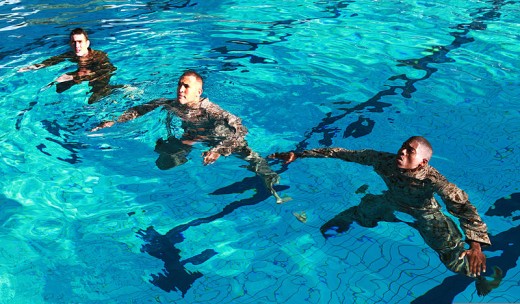
The workout included the physical fitness components of cardiovascular endurance (3-mile run), flexibility (warm-up and cool-down exercises), muscular endurance (maximum effort body weight exercises) and stamina (swimming drills).
EXERCISE(S)
SETS
REPETITIONS
Partial lunge - Hip thrust - Bird dog - Partial squat - Lunge stretch - High knee walk - Standing quad stretch - High knee walk - Standing glute stretch - Donkey kicks - Butt kicks
1
6


Pull-ups*
1
AMRAP
Crunches
1
AMRAP 2 minutes


Jog
1
3 miles


Swim
1
50m
Treadwater
2
2 minutes


Stretch: Calf - Hurdler - Groin - Quad - Lower back - Triceps - Delts
1
20 seconds
* Pull-ups or chin-ups