Showing posts with label core stability. Show all posts

Tuesday, October 11, 2016

Javelin Training to Build an Athletic Butt

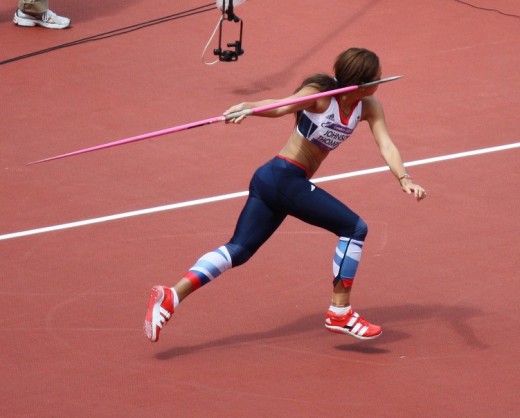
Javelin throwers come in all shapes and sizes. Along with the discus and shot put, the javelin is a throwing event. Javelin throwers tend to be significantly leaner than their throwing counterparts.


General javelin conditioning involves core conditioning, plyometrics, running, stretching and weight training. Due to the nature of the event, core and glutes development is essential.
So it's time to build your own athletic physique with a javelin thrower's training plan. No spear slinging is involved!

CROSS-TRAINING WORKOUT

This cross-training session includes a general warm-up, two core strengthening periods, a circuit-training period, a calisthenics period and stretching.


The intent of the circuit training period is to introduce a circuit involving running mixed with strength-building exercises, maximizing a stamina impact. The calisthenics are designed to build strength and endurance. This first core period focuses on core stability with a plank and bridge circuit. This period is conducted as a circuit with no rest between exercises. The second core period is aimed at developing abdominal strength with several sets of abdominal crunches.

Monday, October 10, 2016

CORE STRENGTH & STABILITY

Training the body's midsection is much more than working to get a six-pack stomach. Core training is critical for good performance. The core section connects the body's upper and lower limbs and acts as the body's power regulator. 


In throwing events such as the javelin, the efficient transfer of force determines the acceleration in which the javelin is thrown and subsequently the distance it is thrown.

Three separate core training cards will be used during this program to address core strength, core stability and core rotation.

Tuesday, September 13, 2016

GENERAL CONDITIONING WORKOUT

A year-round general conditioning workout designed to gain and maintain an excellent overall state of conditioning. This workout includes exercises to develop cardiovascular endurance, core stability and maximum strength.


Cardiovascular endurance is trained and tested using a 1.5-mile run. Each 4 session cycle will include a best-effort time trial, two easy jogs and a fartlek workout. Fartlek is the Swedish word for "speed-play". During the fartlek session; the first and last half-miles are conducted as an easy jog with the middle half-mile run at a vigorous pace.
Core stability and local muscular endurance are developed and tested using abdominal crunches.
Lower body and upper body strength are developed and tested using the barbell squat and barbell bench press. The sessions are cyclic in nature; moving from reps of 5, to 3, then a 1 rep maximum lift. A one week of light lifting ends the cycle. Each work includes 3 sets of each lift. The first set is conducted at 50% of the training/max weight. The second set is conducted at 75% of the training/max weight. If you're doing sets of 5 with 100 pounds being the training weight; the first sets will be with 50 pounds, the second set at 75 pounds and the final set at 100 pounds. This protocol serves 2 purposes. First, it provides a specific warm-up using sub-maximal weight. Second, it conditions your body to lift heavier after you've already lifted. This will help reduce the risk of injury while training yourself to finish strong. The light week includes one set each at 5, 3 and 1 reps all at 50% of the normal training/max weight. As you get stronger, increase the weight in small increments and maintain the 50%-75%-100% lifting protocol.
Tuesday, August 30, 2016

QUICK CORE & FLEXIBILITY WORKOUT

A relatively quick daily workout focused on core stability and flexibility. Several sets of various abdominal and lower back exercises were followed by a 5-minute core circuit. A significant amount of stretching was included during the cool-down period.
EXERCISES
SETS
REPETITIONS
Walk
1
5 minutes
Heel raises - Partial squats - Butt kicks - Trunk bends - Arm circles - Jumping jacks
1
10
Crunches
2
40
Bridge
1
30 seconds
Side planks
1
15 seconds each
Front plank + Hip thrusts + Cobra stretch *
1
5 minutes
Walk
1
5 minutes
Stretch: Quad - Hurdler - Groin - Lower Back - Cobra
2
20 seconds each
* Completed consecutively, 20 seconds per exercise, without rest.
http://hubpages.com/health/DAILY-EXERCISE-PLAN-21-27-August

Saturday, August 20, 2016

QUICK WORKOUT

A relatively quick workout designed to enhance core stability, muscular strength and stamina. Sets of crunches were included to improve abdominal strength while planks were designed to upgrade core stability. Pull-ups were featured to remedy any upper body strength shortfalls.
Prior to the cool-down, an intense 5 minute circuit was included to develop total-body muscular endurance and stamina. The goal was to complete as many rounds as possible (AMRAP) of crunches, squat thrusts, push-ups and dorsal raises completing 5 reps of each exercise then immediately moving on to the next.

http://hubpages.com/health/DAILY-EXERCISE-PLAN-7-13-August

Thursday, August 18, 2016

RESILIENCY TRAINING

Resiliency is the ability to recover quickly from change. This workout will test your resiliency by combining a variety activities in a single session to develop speed, strength and endurance using calisthenics, a conditioning hike and sprinting. 
The calisthenics portion of the the workout emphasized core and lower body movements including air squats, planks and crunches.
Short, explosive sprints were designed to enhance acceleration and quickness. The loaded sprints can be accomplished by pulling a sled, wearing a back pack and sprinting uphill. Keep the weight to about 15% of your body weight.
The conditioning hike was completed wearing a back pack load with 30 pounds. The goal is to improve endurance while carrying extra weight using a moderate pace (approximately 20 minutes per mile).
https://caloriebee.com/workout-routines/STRENGTH-CONDITIONING-Exercise-Plan-for-31-July-6-August

Tuesday, August 9, 2016

ACCELERATION-CORE STABILITY-ENDURANCE WORKOUT

The daily workout combined a variety activities to develop speed, strength and endurance using calisthenics, a conditioning hike and sprinting.


The calisthenics portion of the the workout emphasized core and lower body movements including air squats, planks and crunches.
Short, explosive sprints were designed to enhance acceleration and quickness. The loaded sprints can be accomplished by pulling a sled, wearing a back pack and sprinting uphill. Keep the weight to about 15% of your body weight.
The conditioning hike was completed wearing a back pack load with 30 pounds. The goal is to improve endurance while carrying extra weight using a moderate pace (approximately 20 minutes per mile).

Friday, August 5, 2016

MUSCULAR ENDURANCE CIRCUIT


A relatively short workout with a intense five minute circuit. Several core stability exercises preceded the circuit. The circuit was designed to encompass the muscular endurance and stamina components of physical fitness. Strive to complete as many rounds as possible within five minutes. Complete five repetitions of each exercise then move immediately to the next exercise.

EXERCISE(S)
SETS
REPETITIONS
Heel raise - Butt kick - Partial squat - Trunk twists - Arm circles
1
6


Crunch
2
AMRAP 1 minute
Front plank - Side planks - Bridge *
1
15 seconds each


Crunch - Squat thrust - Push-up - Dorsal Raise *
1
AMRAP 5 minutes (5 reps each)


Stretch: Calf - Groin - Quad - Lower back - Triceps
1
10 seconds each

Wednesday, August 3, 2016

CORE STABILITY & CARDIO TRAINING SESSION


This training session included a calisthenics period followed by a three mile run. The calisthenics period emphasized core exercises.
Core stability is the ability to control the position and movement of the central portion of the body. The core serves as the body's movement and power regulator. An increase in core stability can help maximize one's balance and athletic performance. Additionally, well conditioned core muscles help improve posture and reduce the risk of injury.